
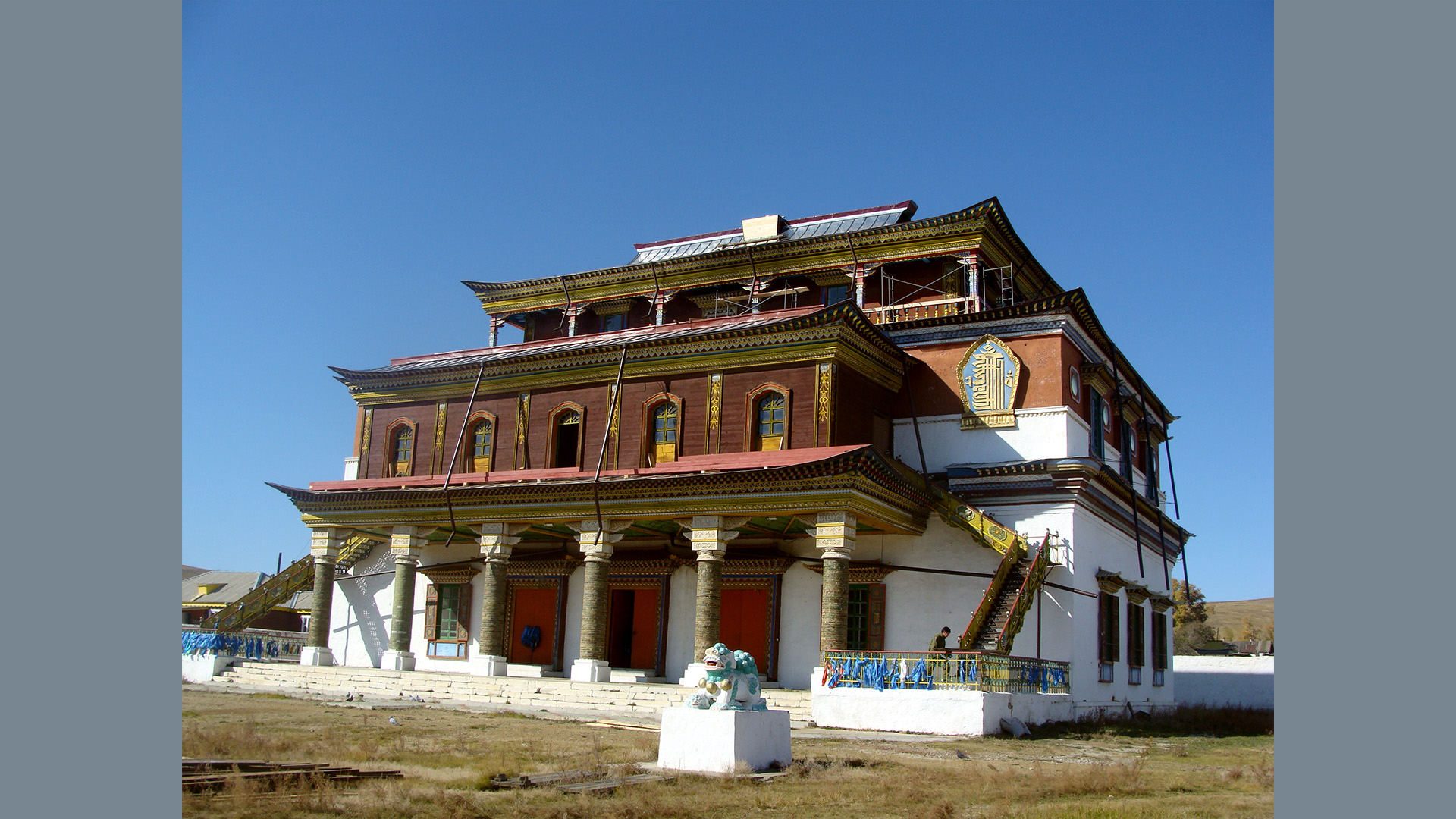
Tsugolsky Datsan.
Object Type
- Ensemble
Monument Type
- Monument of Urban Planning and Architecture
Heritage Category
- Federal Heritage Monument
Designation Decree
Decree of the President of the Russian Federation "On the Approval of the List of Objects of Historical and Cultural Heritage of Federal (All-Russian) Significance" No. 176, dated February 20, 1995.
Address
Tsugol Village, Mogoituysky District
Date of Creation
Second half of the 19th centuryFieldwork / Repair and Restoration Works
1887–1888 – restoration work after a fire.
2013–2014. LLC "Lotos" performed the following types of repair and restoration work: roof repair (repair of rafter structures, replacement of sheathing, replacement of roofing, replacement and restoration of rainwater system elements), repair of the second-tier ceiling, main portal of the second tier, restoration of the second-tier balcony (restoration of handrails and balusters, restoration of decorative carved ornamentation, cleaning of surfaces from paint and soiling, finishing of surfaces using a special technology), replacement of flooring on the balconies of the second and third tiers.
2025–2027.
Description
«According to official history, it was founded in 1801 as a felt dugan (temple) by the Buryat clans of khargana, khuatsai, and galzut near the Urdunui ridge. The guardian deity of the Tsugolsky Datsan is Choijal. In response to a petition from parishioners, the head of the Nerchinsk District in 1827 granted permission for the construction of wooden buildings for the main temple and a sume. The Tsogchen-dugan and Naidan-sume were erected in the same year, and the Maidari-sume, Demchok-sume, and Gunrig-sume in 1831. Four small temples were clan-based (aimak): Naidan and Demchok (khargana), Gunrig (khuatsai), Mahagala (galzut). Common to the entire parish, besides the main temple, was initially the Maidari-sume, later others were established later. The first permanent building of the Tsugolsky Datsan, erected in 1854, according to the project, was a square-based, single-story structure, but with three domes in the form of small towers that had windows. However, there is information that from 1831 to 1836, a three-story wooden building was constructed, with over 200 lamas and 3,000 parishioners gathering for its consecration khural. From the mid-1850s, lengthy correspondence commenced with the provincial administration for permission to build a stone main temple. The Governor-General granted the Tsugol residents’ petition in 1864, approving the blueprint. Construction work was completed in 1869, but in 1887 the datsan burned down and was restored in 1889 ‘on the remains of the stone foundation.’ The builder of the temple was shanzodba Shoibon Namsaraev. Comparing the 1854 blueprint with photographs of the datsan taken in the early 20th century supports the conclusion that the structures were identical. A philosophical school (tsanit) opened in 1845 but initially had no special building, using the aimak Naidan-sume for classes. The issue of building a tsanit-dugan was resolved in 1897. Approximately aligned with it, north of the tsogchen-dugan, was the Maidari-sume, a two-story building with an iron roof on a stone foundation, built after receiving corresponding permission in 1897. The history of the founding of the Manba-dugan, a stone two-story building, remains unclear. In 1866, the Tsugol residents were not permitted to build a ‘prayer house in the name of the god Otochi,’ but it was probably built anyway, formalized in 1877 as a donation from the Aginsk taisha Tugultur Toboev ‘for the repose of the soul of his son – lama of the Tsugolsky Datsan’ G.-Zh. Tugulturov. Dampness penetrated the premises, so the lamas petitioned for the construction of a wooden annex. The project is dated 1914, but it was actually carried out before official permission. At the end of the 19th century, the aimak sumes Demchok and Gunrig were rebuilt; in 1911, the Aryabalo-sume was built for the maani khural (prayer service). In 1913, the galzut clan founded its aimak sume Mahagala. The Tsugolsky Datsan was known, above all, for hosting the first Buryat tsanit and manba schools, whose students later became founders of other Buryat datsans and teachers there. The growing authority of its clergy is evidenced by the recognition here of the first recognized reincarnate lama (ganzhirva-gegen, Buryat: khubilgan) on the territory of Transbaikal Buddhist monasteries. By the early 20th century, the Tsugolsky Datsan comprised twelve main temples and more than ten auxiliary buildings. By the early 2000s, only three buildings remained, including the main cathedral temple. Its architectural appearance represents a benchmark of Buryat religious architecture, whose distinctiveness lies in the synthesis of Russian, Tibetan, Mongol, and Chinese traditions. In 1936, the Tsugolsky Datsan was closed, cult objects were removed, and the structures were transferred to military units. In 1988, it was returned to the Buddhist community. By the early 2000s, only three buildings remained, including the main cathedral temple. Its architectural appearance represents a benchmark of Buryat religious architecture, whose distinctiveness lies in the synthesis of Russian, Tibetan, Mongol, and Chinese traditions. In 2013, design and estimate documentation was developed using federal budget funds, and in 2014 work began on the restoration of the main temple».
Zhamsueva D.S. Tsugolsky Datsan // Small Encyclopedia of Transbaikalia: Architecture and Construction. – Novosibirsk: Nauka, 2016. – P. 446–447. https://ez.chita.ru/encycl/concepts/?id=6917
Tourist Routes
- Included
Infrastructure Development Projects / Other Events
2007: Return of the statue of Maitreya — the Future Buddha.
2011: Re-creation of the statue of Bogdo Tsongkhapa, lost in the 1930s.
2025: The international forum "Buddhist Shrines as Cultural Heritage Sites" was held at the Tsugolsky Datsan.
Historical-Cultural Expertise for Conducting Repair and Restoration Works
- Conducted
Historical-Cultural Expertise (Comments)
Conducted for repair and restoration works.
References
Ensemble of the Tsugolsky Datsan // Unified State Register of Cultural Heritage Sites (EGROKN). URL: https://opendata.mkrf.ru/opendata/7705851331-egrkn/63/183542 (accessed: September 30, 2025).
Zhamsueva D.S. Tsugolsky Datsan // Small Encyclopedia of Transbaikalia: Architecture and Construction. – Novosibirsk: Nauka, 2016. – P. 446–447.