
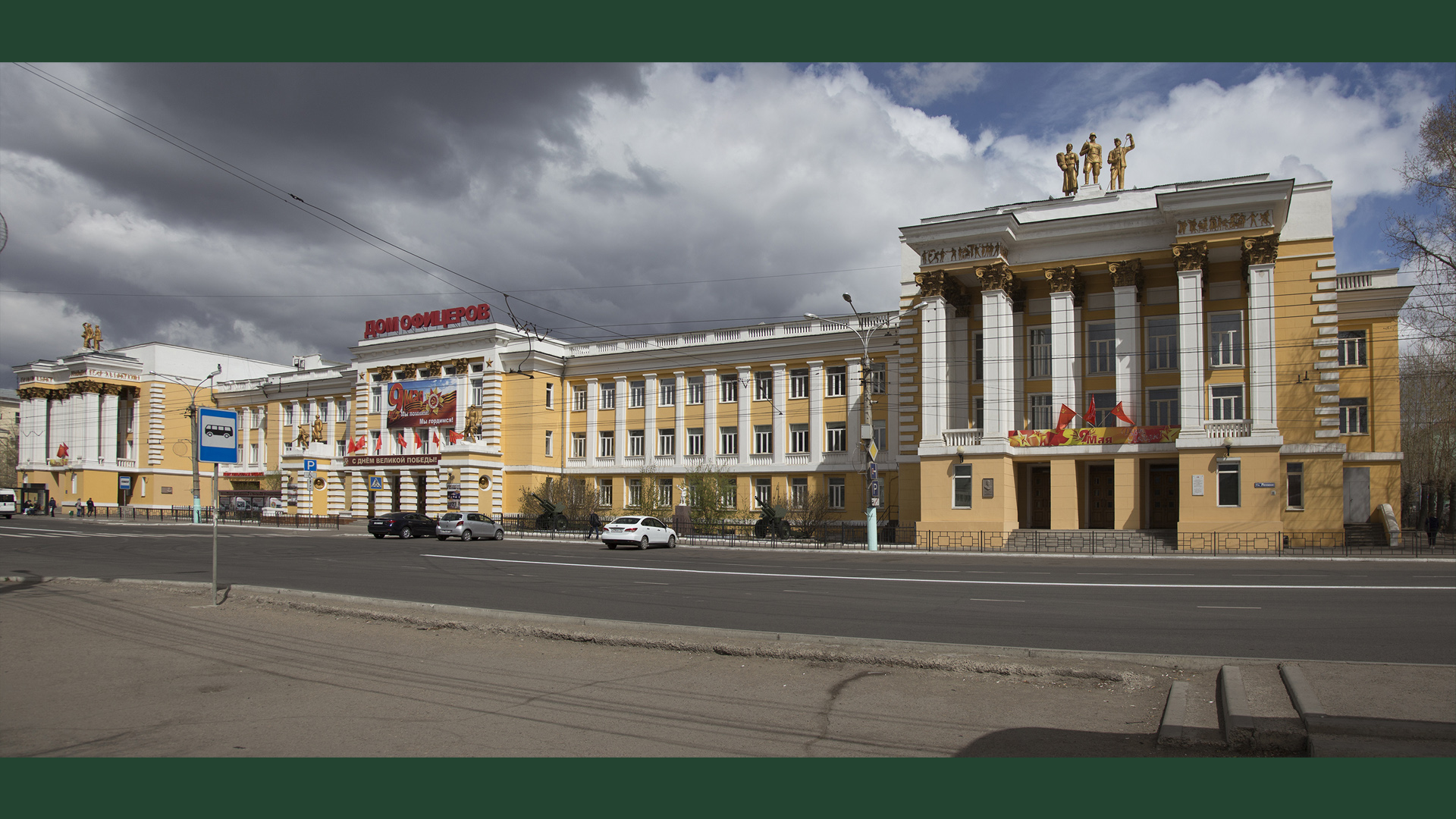
Object Type
- Monument
Monument Type
- Monument of Urban Planning and Architecture
Heritage Category
- Identified Object
Address
88 Lenina Street, Chita
Date of Creation
1939–1940Architect(s)
M.P. Klekovkin
Description
The building was erected based on a design by M.P. Klekovkin—an architect and graduate of the Siberian Construction Institute—under Military Project No. 457. The structure dates to the Soviet era of Chita’s urban evolution. It holds a pivital urban planning role, defining the character of Chita’s streetscape. Within its urban block, it stands as the dominant architectural landmark. The building partially occupies the site of the former Zhukovsky Garden, now known as ODORA park. Construction of the building’s eastern section—located at the intersection of Lenina and Vystavochnaya streets—commenced in 1939. This section accommodated a theater hall, a foyer adorned with marble columns, a small blue hall in the club wing, lounges, and billiard rooms. Intricate decorative paintings on cornices, walls, and ceilings, gilding on column capitals, and wall color schemes were crafted by decorative artist G.A. Fomin. The original building officially opened to the public in 1940. ODORA PARK’s main hall was the finest in Chita, yet the need to expand it and construct an annex arose repeatedly. In 1984, an annex was constructed at the intersection of Lenina and Pushkina streets based on a project by the "Military Project No. 457" institute, preserving architectural, stylistic, and chromatic consistency with the original building. In 1985, the annex was officially commissioned; it is now home to the Museum of Military Glory of the Transbaikal People. As a result, the now three-story complex took on a symmetrical U-shaped layout, featuring three main entrances within the risalits of the principal facade. It distinguishes itself from other contemporary structures through the integration of monumental art elements in both its interior and exterior [...]. The most architecturally significant spaces are the two assembly halls, vestibules, and stairwells. During restoration efforts in 2005, busts of eminent Russian military commanders were installed in the main entrance vestibule.
Tourist Routes
- Included
- Recommended