
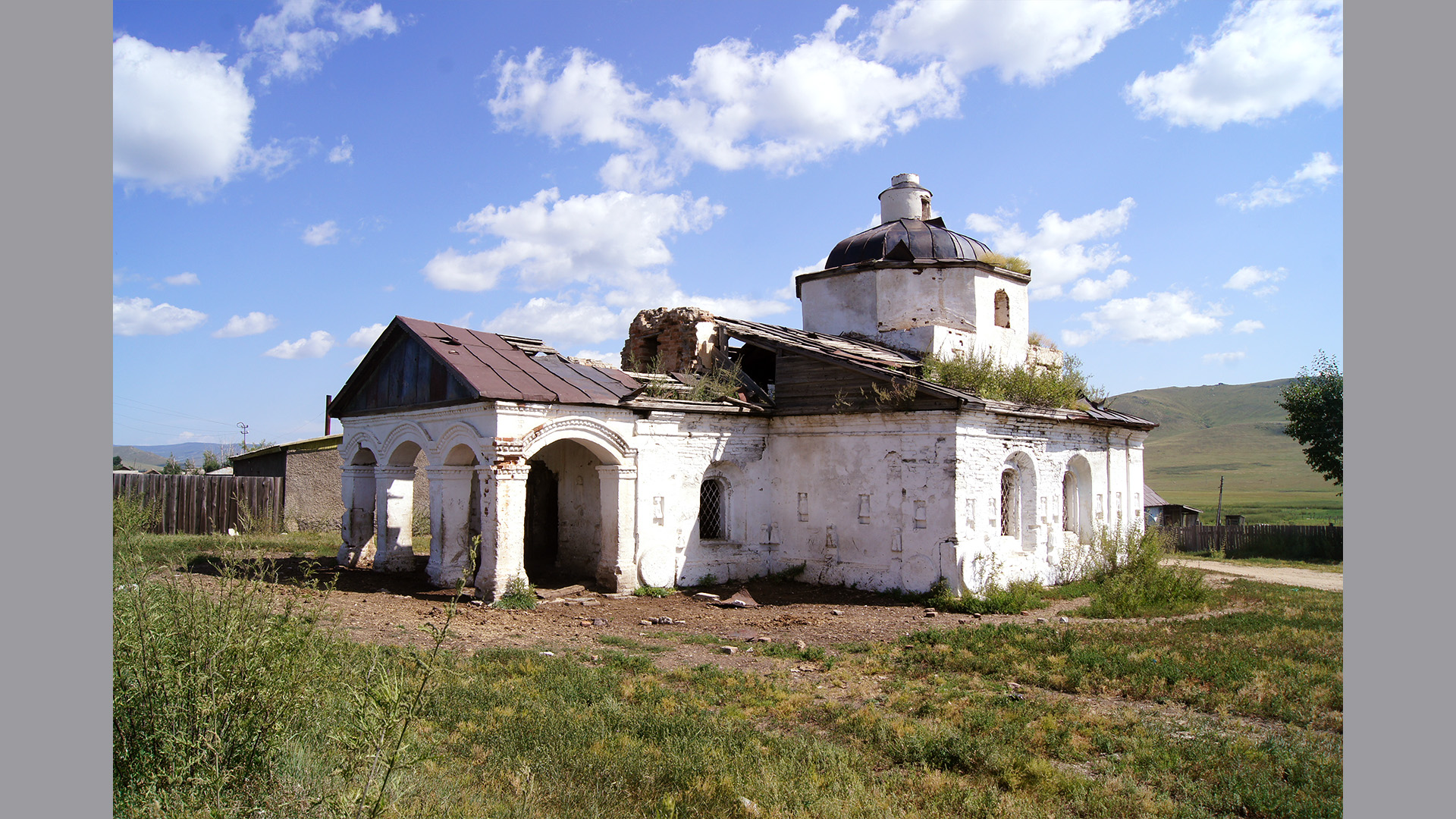
Kondui Church.
Church of the Nativity of the Most Holy Theotokos and the Holy Martyrs Kyrikos and Oulitta.
Object Type
- Monument
Monument Type
- Monument of Urban Planning and Architecture
Heritage Category
- Federal Heritage Monument
Designation Decree
Decree of the President of the Russian Federation No. 176 "On the Approval of the List of Objects of Historical and Cultural Heritage of Federal (All-Russian) Significance," dated February 20, 1995.
Address
Kondui Village, Borzinsky District
Date of Creation
1806Researchers
1925, A.K. Kuznetsov
1979, 1984, N.P. Kradin
2004, Expedition of the Institute of History, Archaeology, and Ethnography of the Peoples of the Far East, Far Eastern Branch of the Russian Academy of Sciences, A.R. Artemyev
Description
«Fragments from the Kondui Townsite, whose ruins lie near the present-day village, were reused as building materials for the church. . The church was erected by local residents with the permission of the Most Holy Synod and Bishop Veniamin of Irkutsk and Nerchinsk. Decorative elements from the ruins -specifically dragon-like sculptures and the column bases from the palace- were incorporated into the church’s construction. These elements were set into the façades: 19 on the north, 13 on the east, 18 on the south, and 14 on the west. They are all arranged in two rows: a lower one along the plinth, and an upper one midway up the wall in specially formed niches. In total, 34 elements appear in the lower, supra-plinth row, and 30 in the upper. The lower band encircles the entire church, including the side chapel. The upper band forms a semicircular pattern: starting from the altar end of the southern side chapel, it continues across the chapel, runs along the remainder of the south facade and the west facade; on the north, it appears only on the refectory wall. The upper band is absent on the altar portion of the church. It is also missing on the north facade of the main volume. Granite blocks that once served as palace column bases are set into the plinth. Projecting outward as circular bosses, they mark the building’s corners and the bases of the pilasters. In his study of the Kondui antiquities, A.K. Kuznetsov observed that the Cossacks’ houses and the stone church, of ‘rather clumsy architecture,’ occupied a beautiful elevated site. All this is indeed evident;nevertheless, the contrast between the low, compressed, entrance/refectory and the high, light-filled main volume can be read as an effective compositional device.These decorative elements from the medieval palace of a Mongol khan, preserved within the church walls, hold significant scholarly and artistic value».
Kradin N.P. Kondui Church // Small Encyclopedia of Transbaikalia. Archeology / ed.-in-chief R.F. Geniatulin. - Novosibirsk: Science 2011. - P. 172-173.
Tourist Routes
- Included
- Recommended
References
Church //Unified State Register of Cultural Heritage Sites (EGROKN). URL: https://opendata.mkrf.ru/opendata/7705851331-egrkn/63/417130 (accessed: Sept 20, 2025.).
Kradin N.P. Kondui Church // Small Encyclopedia of Transbaikalia. Archaeology / ed.-in-chief R.F. Geniatulin. - Novosibirsk: Science, 2011. - P. 172-173.
3. Kradin N.P., Tsyrenzhapova D.E. Church of the Nativity of the Most Holy Theotokos and the Holy Martyrs Kyrikos and Oulitta // Small Encyclopedia of Transbaikalia: Architecture and Construction / ed.-in-chief N.N. Zhdanova. - Novosibirsk: Science, 2016. - P. 442-443.
Tsyrenzhapova D.E. Church of the Nativity of the Most Holy Theotokos // Small Encyclopedia of Transbaikalia: Culture: Part 2: M-Ya / ed.-in-chief R.F. Geniatulin. - Novosibirsk: Science, 2009. - P. 346. 5. Kondui. Church of the Nativity of the Most Holy Theotokos. URL https://ruskontur.com/konduj-czerkov-rozhdestva-presvyatoj-bogorodiczy/?ysclid=mfp0me60d0244060551 (accessed: 20 Septmber, 2025.)