
Vtorov’s Arcade
A.F. Vtorov’s Arcade
Object Type
- Monument
Monument Type
- Monument of Urban Planning and Architecture
Heritage Category
- Federal Heritage Monument
Designation Decree
Decree “On the approval of the list of properties of historical and cultural heritage of the federal (all-Russian) significance № 176. Date: 20.02.1995.
Not included in Russian cultural heritage register at the moment of 2025.
Address
Chita, Anokhina street, 63 (when arming, the address was: Kalinina street, 56 – Polina Osipenko street)
Date of Creation
The beginning of the 20th century, 1911-1912.Architect(s)
Ivan Kuznetsov
Description
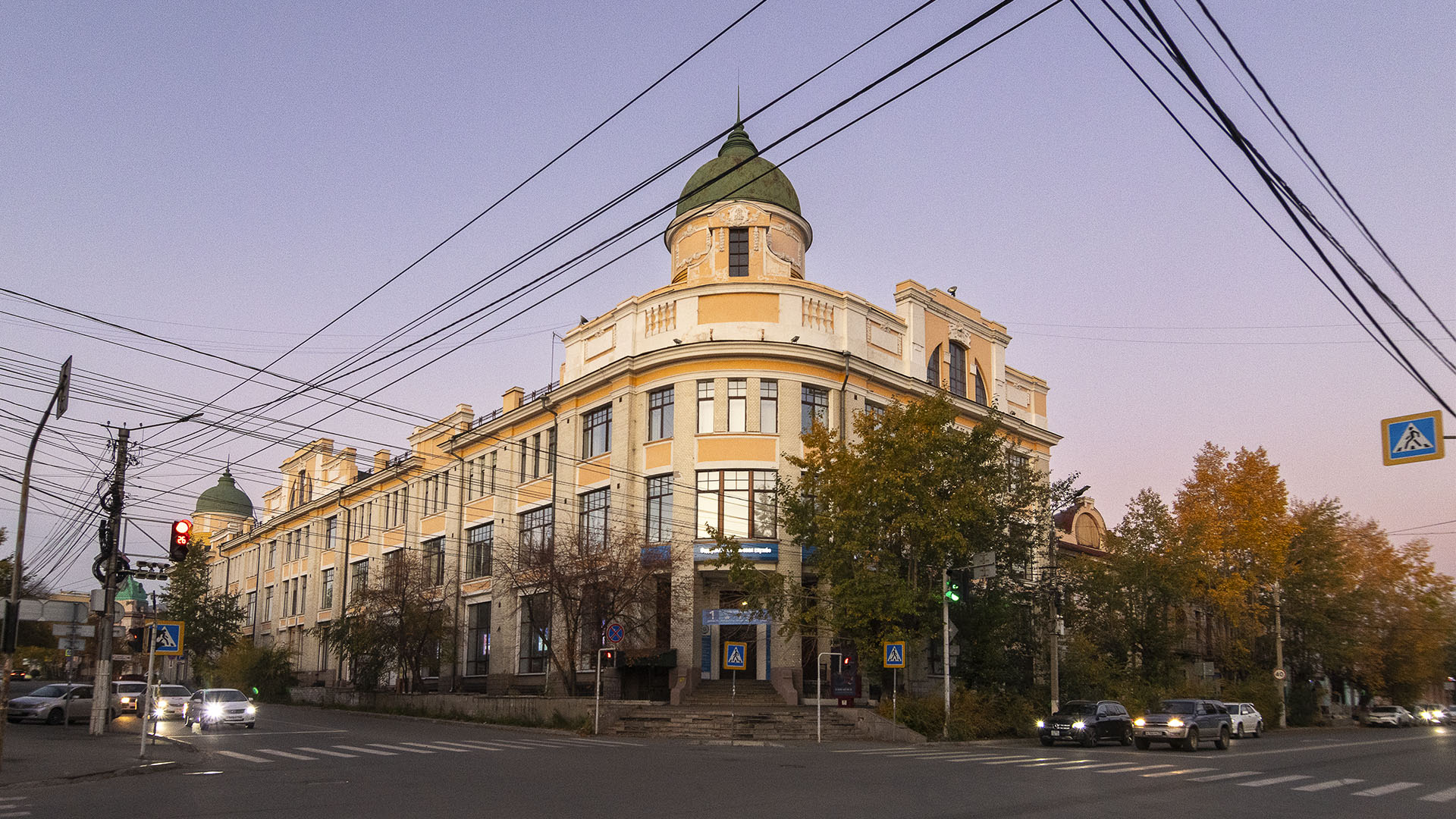
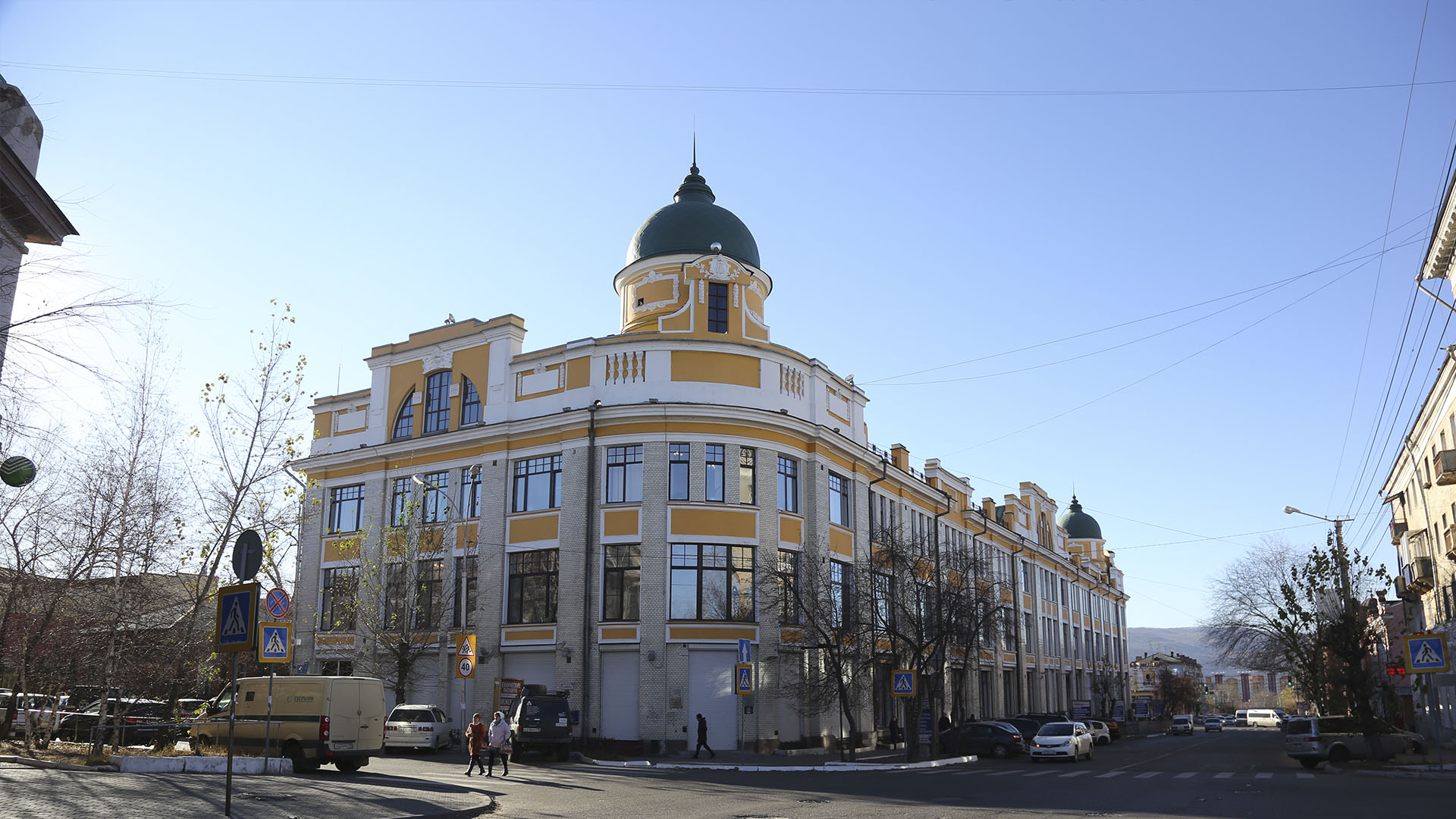
«It was constructed between 1911 and 1912. A.F. Vtorov, an Irkutsk merchant belonging to the first merchant guild, was the client, and D.F. Ignatiev, a Chita merchant, was the contractor. Moscow was the source of the Arcade building project. The rectangular, three-story brick commercial structure is located between Amurskaya and Anokhina streets in a quarter.
A monument of neoclassical civil architecture. Large window planes and pilasters that divide smooth walls serve as the foundation for facade expression.
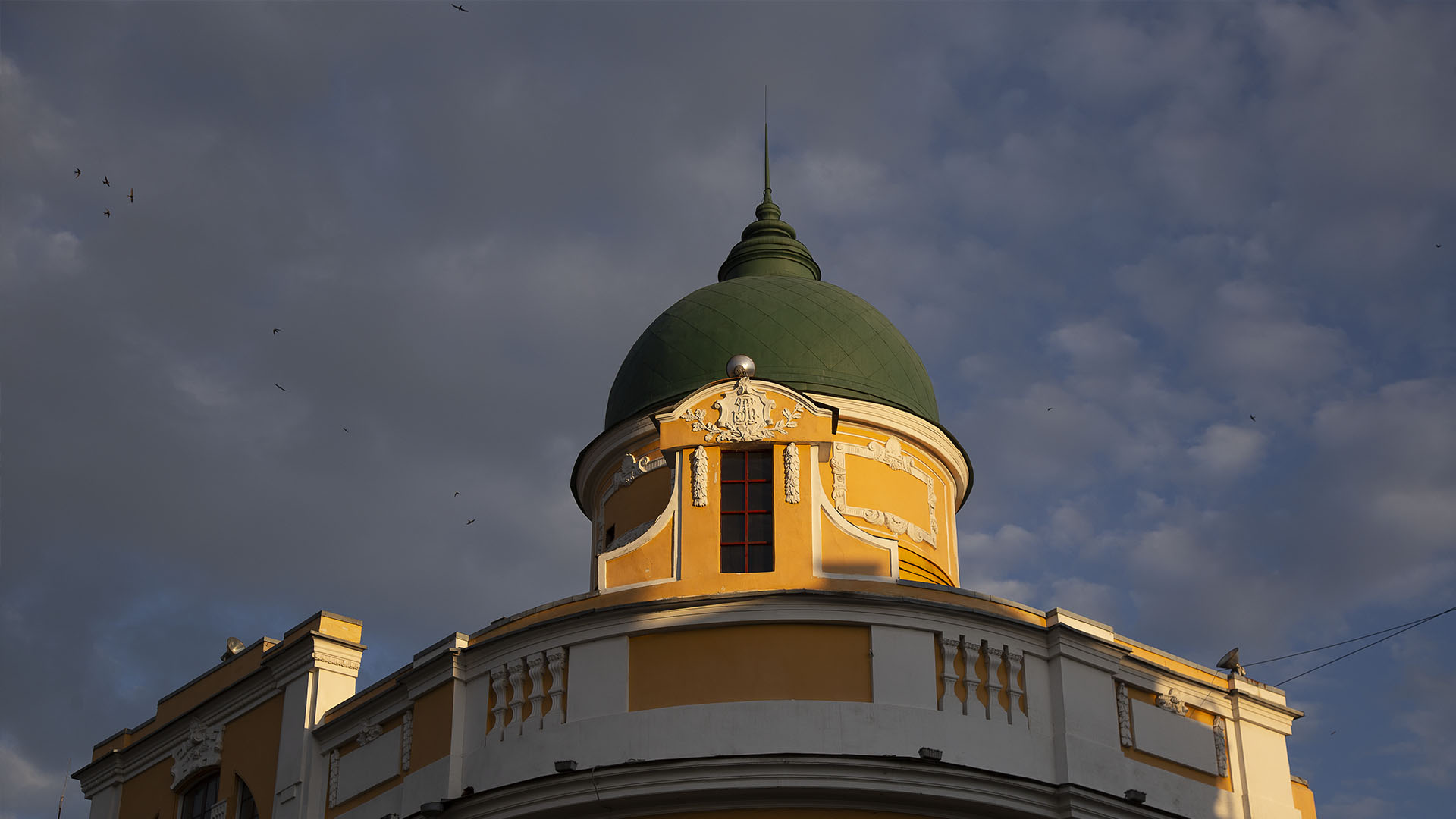
The extended facade facing Polina Osipenko St. is divided by pilasters and has a strictly symmetrical composition. The rounded angles of the house are fixed with domes upon high tholobates.
The first-floor level is where the entrances are situated. The structure is finished with intricate parapets with semicircular attic windows along the centerlines of the facade. Light tiles with a glazed finish cover the facade. Fretwork adorns the parapets. The arcade owner’s plaster monogram was preserved by tholobates beneath domes along the centerlines of the corner entrances.
The building was decorated with tiles and fretwork made at the G.A. Yudovich and Co. Partnership factory. During 1914-1917, the building housed the Amur Railway Administration, in 1917 the branch of the Moscow Narodny Bank, the Chita Commercial College and the Chita Polytechnic Courses.
The Far Eastern Republic’s Constituent Assembly convened on February 12, 1921. A plaque on the building indicates that the Council of Ministers, the Ministry of National Economy, and the Ministry of Industry and Trade of the FER were housed here in 1921–1922. The Far Eastern Revolutionary Committee was housed in the Arcade building following the Republic’s dissolution. The Administration of the Transbaikal Railway was established in 1925. Transbaikal Gold Bank existed in the 1990s. Zabaykalsky Krai has been home to the Russian Federation’s Federal Taxation Service since the late 1990s. The Federal Service for State Registration of Rights to real estate and dealings with it in the Chita region has been a part of the State Institution of Justice since 2000».
Khamina N.I. Passage Vtorova [Vtorov’s Arcade Building] // Encyclopedia of Transbaikalia: Chita region: Vol. 3 / chief editor R.F. Geniatulin. Novosibirsk: Science Publ., 2006, pp. 416-417.
Tourist Routes
- Included
- Recommended
Historical-Cultural Expertise for Conducting Repair and Restoration Works
- Conducted
- Planned
Historical-Cultural Expertise (Comments)
2018 - Act of the State historical and cultural expertise.
References
Khamina, N. I. (2006). Passage Vtorova [Vtorov’s Arcade Building]. In R. F. Geniatulin (Ed.), Encyclopedia of Transbaikalia: Chita region (Vol. 3, pp. 416–417). Science Publ. https://ez.chita.ru/encycl/concepts/?id=5505
Author. (n.d.). Act of the State historical and cultural expertise [PDF]. Редактор.Забайкальскийкрай.рф. https://xn--80ahcwuhfo.xn--80.pdf
Rostender.info. (n.d.). Carrying out works to preserve the cultural heritage site of the Vtorov Building. https://rostender.info/tender/69509953
Khamina, N. I. (2016). A. F. Vtorov’s Arcade Building. In N. N. Zhdanov (Ed.), Small Encyclopedia of Transbaikalia: Architecture and construction (pp. 309–311). Science Publ.
Khamina, N. I. (2014). Vtorov’s Arcade Building. In K. N. Ilkovsky & A. N. Mikhalev (Eds.), Encyclopedia of Transbaikalia: Chita (pp. 379–380). Science Publ.
Khamina, N. I. (2009). Vtorov’s Arcade Building. In R. F. Geniatulin (Ed.), Small encyclopedia of Transbaikalia: Culture: Part 2 (pp. 138–139). Science Publ.